Blog

Summer Thunder

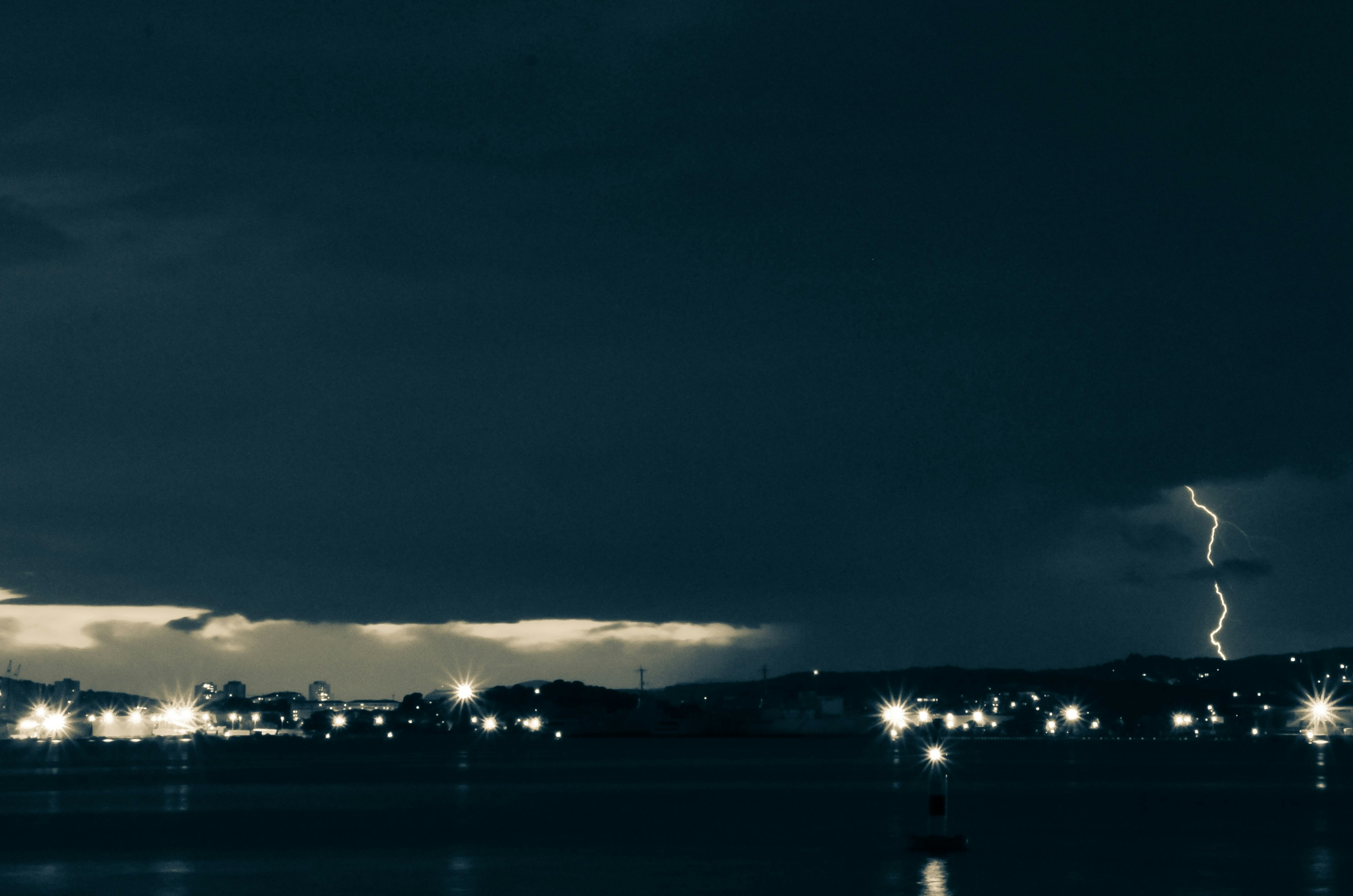
I woke up last night to the skies rumbling—like horsemen storming through the heavens, white light lancing through the thunderclouds. Curtains of water unleashed on our dry and thirsty streets. They fell in ceaseless waves, like mercy and mourning.

Do you ache for the broken beauty? The splendor of creation, diminished in our minds and narrowed to the small confines of our festivities, troubles and traffic jams.

We spin in the familiar orbit of our daily routines, insignificant creatures on a blue orb soaring through space. Stars wink out of the universe, their violent gaseous flames extinguished, and our lives continue untouched. Galaxies bend and spiral into a black unknown and we linger on, blissfully unaware. What is man, that You are mindful of him?

But when the thunder rolls, I am cut with heavenly hunger.

We spin, a world made for heaven but flying straight towards hell. We stand at once in rebellion and in shame, with one hand thrown into a fist against the skies and another chained to the collar of corruption. People cry out in a hailstorm of contradictions. Truth is a joke and life is cheap. But still we fight so hard—stirring words and bloody bodies—but for what?

We hate hypocrites yet find them in the mirror. I will preach the full and unmatchable value of life, of the equal worth in yours and mine. But when the waters rise, I’ll know, painfully and clearly, how empty pretty words are if I can’t trade my mortality for yours.

How much we need someone who sees us all the way to the core, in a wreck of frailty and failure, and loves us even in agony.

Do you ache for glory undimmed? Think hard and search deeply and tell me. Because I don’t believe you’re an existentialist. You don’t want to watch the world burn. You want to be on the right side of history with your trumpet of justice and kindness, these noble things that have no meaning in a world that exploded from nothing for no purpose. Simply to spin and spin and spin and die.

Like a diamond in the rough, lies only spring from pale imitations of truth. And it is there—the truth and the glory—gleaming beneath the dirt and grime. A crimson flower, blooming in the ashes of ravaged land. Creation groans, but not without the silver edge of hope on the horizon.

I listen to the rainfall and the roar. The mercy and the mourning. Our little corner of our small world trembles quietly.

But one day the skies will rend wide open for Heaven and Earth to collide. You will fling off the dark covers and creation will shrug off its old burdens. Shadows flee. Beauty unbroken. Glory undimmed.

Have we seen Light, until we see that day?


Inspiration 101

“Oh Captain my captain!”

I watched Dead Poet’s Society a few days ago for the second time, and it was even better than I remembered. Robin Williams was gold as Mr. Keating, and I didn’t fully appreciate before what a stellar supporting cast he had (Ethan Hawke? Josh Charles? well, I had no idea who these people were when I watched it in high school). The story builds up to a tragedy, but it is not without humor and triumph. It is innocent, but not naïve; philosophical, but accessible; wise, but not preachy.

It made me wonder about the stories that inspire us. What springboards something from unremarkable to unforgettable? I thought it was one of those hazy, hard-to-define things but I wanted to pinpoint a few key elements. You could say some stories just have it, a mysterious, magical X factor, but crafting a good tale isn’t like waving a wand. So I thought through my favorite books and films and came away with some common themes.

A hero who overcomes what we cannot

The stories that take a step beyond the plane of reality give themselves the liberty to create a larger-than-life protagonist: someone who can fight the battles and lead the charges that ordinary people can only dream of. They stand against seemingly insurmountable odds, and they sometimes stand alone (or at least vastly outnumbered). Basically, every superhero movie or fantasy novel where good defeats evil in a glorious spectacle.

They are the characters we will never be, but they move us with their valor and nobility. We may not have their abilities, but we can aspire to live with the same spirit.

A hero who overcomes a relatable weakness

I think there’s a large class of people that we’d look down on in the streets, but we’d love if we found them between the pages of a book.

While we’d all like to be crushing villains and taking names, most of us are fighting smaller, invisible battles each day. We’re frail, breakable, and often barely holding things together. When we don’t know someone’s heart, it’s easy to judge by appearance. That’s the wonderful thing about stories—they teach us what is often hidden behind facades in real life. They make us cheer for the poor, geeky outcast who, let’s be honest, not many of us would have befriended in real life. They make us fall in love with a man who few would probably tolerate the company of (yes, you, Mr. Darcy).

Awkwardness. Fear of what people think. Anger over irrational issues. Relationship problems. When we find characters beating the challenges we face ourselves, it inspires us to keep fighting too.

A vision of the future that is better than today’s reality

Hope and hopelessness, the two opposite ends of the spectrum, are both capable of instigating reckless actions. Our society is familiar with the latter. Desperate men with nothing to lose can do an extraordinary amount of damage.

But hope can lead to reckless living too—in a good way. Paul was utterly sold out for Christ because he believed in the deepest part of him that his present suffering could not compare to the glories to come. In fiction, this may be best seen in fantasy or sci-fi. Heroes who refuse to live under a shadow of evil or fear, who will give their all for the sake of a brighter future.

Hope can make humanity rise above a bleak reality.

Style

Style without substance is meaningless. But substance without style can range from boring to terrible. Style binds good substance together and makes it shine.

There are stories with all the “right” elements jammed in but executed poorly. Not going to name names, but we all know the ones that had so much potential in character or premise—and they flopped.

And there are some stories that are made great by their stylistic choices. If The Book Thief were narrated by anyone else, it would not be as brilliant. Probably still a decent story, but not stunning or truly set apart. Every single human being has many ordinary stories they can tell. Only a few become classics, and while it’s most often what you have to say, how you say it can also set the literary world spinning.

So…lights! Pens! Action! What inspires you? That, to me, is one of the great purposes of art and storytelling. We don’t create fiction in a vacuum: we create to reflect reality and inspire people to live more boldly and compassionately.

Carpe diem!

Still Growing Up – Thoughts on “Go Set a Watchman”

Oh hey. I know I’ve vanished for the better part of a month – life changes, busyness, lack of inspiration, and all that jazz. But I’m back, and with a (long-winded, most likely) review of Go Set a Watchman, which I couldn’t resist buying early and devouring in the course of a day. I was apprehensive as some early reviews drifted into my purview – everything from the book being a shameless money grab, to Lee ruining one of the most beloved literary figures of all time – but I have an incurable sense of curiosity. And, in all honesty, I wasn’t going to not read a To Kill a Mockingbird sequel. Some spoilers ahead. 

CHILDHOOD, CAPTURED

Harper Lee has such as keen grasp of children, their nature and way of thinking. It was apparent in To Kill a Mockingbird, and she brings the same warmth and emotion to writing some significant flashback scenes in Watchman. This was one of my favorite parts of the book – finding new anecdotes of Scout’s early days in Maycomb, full of hilarity and moving character insights. There’s her, Jem and Dill reenacting a religious revival and Scout being caught naked by the reverend with her father; there’s Scout living with the terrible thought that she’s pregnant for nine months because of girlish rumors from school; and many more. Like Mockingbird, Lee continues to deal with some serious moral issues in her novel, but so much of her story is wrapped around simple tales of growing up in a small town with unforgettable characters, and how they leave a mark on you for life.

On a side note, I can understand why publishers wanted her to write Mockingbird and publish that instead because I found her flashback scenes to be the best part of Watchman, though they were scattered throughout in a much less structured plot than her first novel.

Did Harper Lee ruin Atticus?

This made me afraid of picking up the book, because Atticus is one of my favorite fictional characters, and if there was one unavoidable spoiler about Watchman, it was that Lee turned him into a racist. Maybe this made me brace for the very worst, because I thought she made him into some kind of a raving madman – but it was quite the contrary. I actually found him terribly consistent as a character. Still a gentleman through and through, with a sharp mind and opinions entirely his own. Yes, you can quote him from Mockingbird and quote him from Watchman and be horrified at some of these juxtapositions, but he is still Atticus. I won’t get into the politics and race relations (and I’m sure this has been and will continue to be one of the book’s most talked about aspects), but I will simply say this regarding his character: Atticus is human, and the philosophy and culture of his times inevitably will have their effect on him, just as they do on all of us. This isn’t to justify his views, but to understand him, and how Lee humanizes him.

The outrage over his character is mirrored in the outrage Scout feels as she tells the story. I wonder if it’s poetic in one sense – that we have “grown up” with Scout, we have idolized Atticus with her, and we have watched him fall, all through her eyes. Atticus is no longer the hero of this story, his daughter is. Lee uses his character’s evolution as a springboard for developing Scout – she would not have the passion and conviction she does if she wasn’t her father’s daughter, and she would not have shown it in Watchman if her father remained exactly the same.

Still Growing Up

One review I read put it this way: Mockingbird is about Scout discovering her father is a god; Watchman is about Scout discovering her father is not a god. My take on it is this: Mockingbird is about a young girl discovering the world and its people can be extraordinarily, irrationally cruel. Watchman is about a young woman discovering that even our heroes are human. It is another tale of growing up, another coming of age, but in a more nuanced and specific way. Haven’t we all experienced both? Isn’t the reality of our heroes’ flaws so much more painful than the reality of the world’s brokenness? Atticus was never perfect – but he was nearly that in Scout’s eyes for most her life. One story is about shedding some of childhood’s innocence, another is about coming more fully into adulthood.

Overall, Watchman was good. Compared to the average novel put out today, it’s very good. Compared to Mockingbird, it falls short. The narrative flow of Watchman is not as strong, and the emotional impact is heavily dependent on its predecessor – the blow Scout feels from Atticus is doubled if you know the Atticus of Mockingbird (though Lee brings a lot of that to light within her new book too). The scene with Cal is heartbreaking. Yet, her storytelling ability, sense of humor, and understanding of human nature is still excellent, uniquely hers, and reminiscent of her first classic.

I’ll admit, I breathed a sigh of relief when I closed the book still loving Scout and Atticus. And sure, someone’s in this for the marketing and money, but I had a good time too – so thanks for unearthing Watchman. 

The Truth About Your Fairytale

Yesterday, you told me about a boy who wears a crooked grin and plays with hearts like they’re poker cards. We sat in a rundown coffee shop, our piping hot cappuccinos blowing smoke into your tired eyes. Like Han Solo, you said, and a ghost of a smile reached your lips. I wasn’t sure if it came from a memory or the knowledge that I’d appreciate the reference.

I’m sorry, I said, before you even told me the story. Because you are like me—not a Princess Leia, who looks stunning in white and inspires men to die for good causes. No, we are Meg Ryan from Sleepless in Seattle, closet romantics until our idealism gets stomped all over. We are the ones who believe in soulmates, first love, and forever. We are from a generation raised on a diet of fairytales, and the first broken heart we meet is our own.

Yesterday, I told you about a boy whose antics could put Nora Ephron to shame. He wasted gas, sleep, and dreams on me. He made August nights perpetually sound like Ed Sheeran and my apartment smell like Calvin Klein. But it’s not like the books, I murmured. The sweetness comes with scars, and the idea of having eternity in one moment is a myth. If we could, why do we always want more? How absurdly helpless we are to squeeze the infinite into a flickering breath.

Is it better to have loved and lost than never to have loved at all? Yes, you whispered, adamant, but I know that’s your romanticism battling down your grief. That was always my response too—almost born more out of principle than conviction. Almost, but not quite. Because I think I would have loved him anyway, knowing it would end. I might have judged you, but for that realization, I ached with you instead. We are all fools in love, I offered, drawing upon the inimitable wisdom of Jane Austen.

Young, innocent, and a little heartbroken: it makes a cocktail of daring and desperation.

Yesterday, you told me you were waiting. Waiting for the pain to pass, waiting to be the Cinderella in your fairytale. Waiting for the one who would sweep in and make all the past a distant thing. It’s like I’m holding onto a single glass slipper, waiting for someone to knock on my door with the other one. I don’t know if he’s lost, stuck in traffic, or nonexistent. We laughed, and sometimes I think that is our greatest answer to agony.

The coffee burned in my throat going down. I don’t think he’s coming, I said.

Perhaps it is better to have loved and lost, but it is best to love and never lose. I think that’s what we’re made for, and that’s what our fairytales are grasping for. We are not created for tragic romances and hurting hearts. Romeo and Juliet sagas romanticize a broken reality, but Cinderella stories reach for Eden-like eternity. We don’t have the words that follow happily ever after because we haven’t lived that tale yet.

Someone who will cover all your scars and never leave you with another one—he isn’t coming.

He’s been knocking on your door for a long time already.

The Insatiable Search for Story

Epic film trailers have been exploding onto the Internet all year, from Jurassic Park to Avengers to Star Wars. I am as stoked as the next gullible fan, prepared to throw my money at these shameless, endless franchises, unless Rotten Tomatoes convinces me otherwise. It got me to thinking—we keep trying to tell bigger tales of wild future concepts, mind-bending thrillers, and edgy what-if scenarios. Why are we constantly seeking more?

Of course, there is the constant criticism of our digital, attention deficit generation. Without explosions, firefights, or eye-popping visuals, you can’t hold an audience in 2015—and sadly, that line of thought turns the art of storytelling into a soulless machine. The same goes for literature (or what passes for literature), as lengthy prose is tossed in favor of quick action. We are the generation of instant gratification.

But we are still story lovers. In an era of fads and viral trends, good stories manage to cut through the noise and endure. Writers continue to find ways to spin up new and better tales, and readers continue to hunt for the next best thing. Though inundated with flashy, sensory material, we learn to strip away the packaging and find the heartbeat. Why are our souls seared with a hunger for story?

We crave closure.

A common complaint I see in book reviews are about loose ends. “The author never explained…” or “But what happened to…?” We love a good resolution. Often, that means a cheerful ending, but not always; there are the tragedies that resolve more beautifully than a trite happily ever after. Perhaps the death of a character was made of the stuff of legends—honorable, symbolic, and sacrificial. It was meaningful, or it achieved a greater end that justified the loss. In essence, it brought closure to the story, or at least one chapter of a greater tale.

Our imperfect world rarely offers the luxury of closure, even in great lives. I recently read Unbroken, the remarkable biography of Louie Zamperini. But even in his stunning story arc, there are numerous “loose ends:” men who met senseless deaths in the war and redemption that did not reach full-circle for all. As much as I loved his tale, I wished a different conclusion for some of the characters.

Closure is not the norm for true stories, yet we long for it, and have made it an integral part of storytelling.

We are made in the image of a Creator.

To tell a story is to create. Based on our knowledge, experiences, and observations, we weave elements together to produce something new. In one way, stories are the seed of countless creations, the motivation to action. A single dream grows into a new technology. A single tragedy sparks a revolution.

God is the first Creator, and the first Storyteller. When we look at the course of human history, fraught as it is with strife and sorrow, we see the nature of creating and imagining shine through different cultures and continents, embedded in our humanity. We simply can’t stop making things and telling stories as we find beauty beyond the brokenness.

We are finite, seeking the infinite.

No manmade story can capture all the emotions and complexities of life. We applaud works of literature when they excel in one area—Lord of the Rings for its sweeping imagination, Anna Karenina for its human insight, Sherlock Holmes for its clever wit—but we can’t form an intelligent worldview based on a singular human narrative.

All inspiration and stories are imaging God’s intricate creation and immeasurable story that extends beyond time. We can’t capture the infinite in the finite, the eternal in the temporal. But we can, and we will, keep telling stories to kingdom come because there are always unexplored angles, unanswered questions, and a universe still waiting in the wings for its final resolution.

The Knot

Is this folly?

To bind ourselves, flesh to flesh,
in blood and brokenness
and whisper, in defiance,
against the dark: ‘til death.

To mock futility, souls conjoined,
despite the mortal sting
and laugh in the face of emptiness
with this communion sweet.

To die daily, for love asks more
than words—it demands our life:
every frail breath and thought,
a living sacrifice.

Or is this divine?


Featured in Germ Magazine November 2015.

Young, Reckless and Nonconformist – Religious Thoughts on “Blue Like Jazz”

BluelikejazzI finally read Donald Miller’s Blue Like Jazz, a few years behind its explosion onto the Christian book scene. I’m not very good at writing book reviews because I tend to get long-winded and dig a hole into one idea, but I felt compelled to share some thoughts. (For excellent and witty book insights, I recommend my friend Veronica!)

Miller is something of a controversial writer in Christian circles, often associated with the emergent church, but I believe he doesn’t consider himself party to that movement. His emphasis on feelings and experiences tend in that direction, though he holds to the depravity of man and the need for salvation. He speaks to an increasingly polarized culture and subcultures of Christianity, and for that I applaud the naked honesty and vulnerability in his writing, which inevitably garners critique from various groups. (And it has—I’ve skimmed the Goodreads reviews.) Needless to say, Blue Like Jazz comes with a host of strengths and weaknesses. I will say up front, though, that I don’t plan to rehash some of the widespread critiques I’ve already seen from many in the conservative, Reformed corner: he’s all about emotion, lacks a high view of Scripture, fuzzy on atonement, and on. I agree with a large part of the criticisms (not all), but at the same time, he’s writing more of a memoir, not a theological treatise. So I want to try to look at it as such.

What I Liked

He’s a good storyteller—humorous, compelling, honestly irreverent (which is sometimes refreshing, sometimes inappropriate), and surprisingly shrewd. Some reviews accuse the book of being nothing more than a meandering diary, but he manages to make that form engaging enough. I particularly liked his stories of living in Portland and attending Reed; it struck close to home for me, and he relates his tales in an up close, personal way, as if you were chatting over coffee in a hipster café.

Dying for something is easy because it is associated with glory. Living for something is the hard thing. Living for something extends beyond fashion, glory, or recognition. We live for what we believe.

He’s honest and real—in a way that can be scary and bold, as he gives a voice to universal but rarely spoken doubts, struggles, and desires. I do think he almost elevates the importance of self-expression and authenticity above objective Truth, but then again, the entire book is a product of his self-expression.

They are lonely. I’m not talking about lonely for a lover or a friend. I mean lonely in the universal sense, lonely inside the understanding that we are tiny people on a tiny little earth suspended in an endless void that echoes past stars and stars of stars. 

He has a sharp gaze into the human soul—I can’t quite compare him to C.S. Lewis, but I found some gems in the book that were reminiscent of Lewis’ insight. The unique edge Miller brings comes from the very different culture he grew up in, and how the severe rift between postmodern thought and conservative Christianity shaped his perspective. Having lived and breathed in both sorts of communities, his observations and struggles resonate with me (and I would guess, with many in our generation).

Somehow I had come to believe that because a person is in need, they are candidates for sympathy, not just charity. It was not that I wanted to buy her groceries, the government was already doing that. I wanted to buy her dignity. And yet, by judging her, I was the one taking her dignity away. 

The Self-Addiction Cycle

Early in the book, Miller expresses his belief in human depravity, and he describes coming to the realization in a personal way.

“Do I want social justice for the oppressed, or do I just want to be known as a socially active person? I spend 95 percent of my time thinking about myself anyway. I don’t have to watch the evening news to see that the world is bad, I only have to look at myself. I am not browbeating myself here; I am only saying that true change, true life-giving, God-honoring change would have to start with the individual. I was the very problem I had been protesting. I wanted to make a sign that read “I AM THE PROBLEM!”

He goes on to speak of our helpless, natural self-addiction many times over. He says, “The most difficult lie I have ever contended with is this: life is a story about me.” I couldn’t help but find it somewhat ironic that the overall theme of the book radiates with an intense focus on self. He repeatedly writes about his opinions and views almost as if they were a law unto himself—his dissatisfaction with relationships, with churches, etc. It made me wonder, “So how did the Gospel rescue him from self-absorption?” He speaks of the inestimable value of love and sacrifice, and how he found beautiful examples of that in the world outside the church. Perhaps this is where our theology comes into play, because I don’t see how one can truly begin to overcome the depth of depravity apart from bringing the full Gospel to bear—Christ’s substitutionary atonement for sin, and His righteousness alone credited to those who believe. I get the sense Miller has a strong grasp of the Gospel’s core, yet his book blurs a lot of lines. It leads me to ask: If he believes in the fullness and centrality of the Gospel, wouldn’t his writing display it?

In short, he shows a keen sensitivity to our innate self-obsession and he speaks of the need to grow in Christlikeness. I can’t help but think of John 3:30 – “He must increase, but I must decrease.” As the outcome of Miller’s conclusions, I half-expected and half-hoped his memoir would naturally grow in speaking more of the glories of Christ and the Gospel and less of himself. Not because “that’s what you’re supposed to do in a Christian book” but because “I have been crucified with Christ. It is no longer I who live, but Christ who lives in me. And the life I now live in the flesh I live by faith in the Son of God, who loved me and gave himself for me (Galatians 2:20).” He believes that wonder is the best worship of God, yet what aspects of God command his awe, and where is his authority for the character of God? I’m sure he can give an answer, and I wish he had in the book.

The Division of Head and Heart

Miller brings a flavor of mysticism to his view of God, denying the need or ability to rationalize the spiritual. His story is an interesting case study of many drawn to postmodern, emergent breeds of thought—young, highly intellectual and educated people who seek to divorce intellect from spirituality. It’s an odd but strangely trendy phenomenon in our culture today.

While many flying the flag of Christianity over the centuries have sought to make faith viable by shutting down science, compromising to science, co-existing in supposed contradiction yet peace with science, etc., biblical faith never needs or seeks to do that. The Truth is able to appeal to the heart, mind, and soul and withstand the test of being embraced by our entire being, without turning a blind eye or fleeing from tough questions. False religions are the ones that latch onto one part of our faculties alone with an iron grip (e.g. science-as-religion that speaks to the intellect exclusively; spirituality that speaks to the heart and emotions exclusively).

And yet, we are sinners, imperfect in all our ways, and none of us achieve that right tension of loving the Lord with all our heart, soul, strength and mind. Miller falls into the “heart and soul” camp more than the “mind,” but those on the opposite end of the spectrum can surely learn from his basking in the “pure and furious” love of God and compassion for the lost and needy. These things can be lost in a narrow focus on doctrine. At the same time, I think Miller’s love for and faith in the Gospel comes with the undeniable influence of postmodern thought, which favors experientialism over doctrinal conviction. But doctrine is not simply for intellect’s sake, and deep theology and knowledge of truth is the firmest foundation and fuel for abiding love. Love for the sake of love is meaningless in the end and will not hold up in the face of our sin and brokenness. I think Miller would agree with that.

In closing, I’d echo his own well-spoken belief:

“I don’t think any church has ever been relevant to culture, to the human struggle, unless it believed in Jesus and the power of His gospel.” – Blue Like Jazz

Wanderlust

Won’t you come, and walk these rugged roads with me?

We can drive that beat-up van through stretches of golden cornfield, dappled with dying sunlight, listening to the tired hum of the engine and wondering breathlessly when it will sputter and give out. Dusk descends and the crickets come alive with their calls—a song to the last embers of summer, a mournful goodbye to a lover.

A crack and sizzle snap the rhythm of the nighttime harmonies and the engine is gone. But this is where the real adventure begins. This is the part, in The Voyage of the Dawn Treader, where they sail past the Lone Islands, and there are no more maps, no more plans, only dreams. This is the part where the thrill of uncertainty sets into our bones the way deep crimsons and oranges have inked themselves into autumn leaves.

We’ll wade through the knee-high grass and weeds, run until we collapse, and sing old songs under the unfurled scroll of stars. And miles and miles later, we’ll find an airport and buy two one-way tickets to see the mountains of the world.

Thousands of feet off the ground, we’ll find another sort of sea, lost in the white tumble of clouds blending with snow. Sweating and bleeding from cuts, shivering from icy gales. Lightheaded with euphoria. Barely breathing from the thinness of the air. The taste of Death and Heaven both suddenly too close, but not the taste of fear—we threw it off the steep slopes on the way up, listened to its shrill shriek swallowed by the winds.

Won’t you come, and walk these rugged roads with me?

We can cut across red deserts and ancient pyramids and the city of kings. Press the soles of our shoes against the hot sands and stones that once touched the feet of a God. Fishermen may still be casting their nets. Beneath hails of gunfire and the terror of modern warfare, men may still be teaching about a kingdom that does not fade. Souls passing from death into life.

Snaking through the knot of bodies, we’ll watch a foreign city come alive with night-lights and signs we don’t understand. Voices fly past us in strange languages and bands play on the street corner with makeshift instruments. Dancers step to the beat, and the bloom of bright dresses decorate the evening.

When we grow weary of the people scenes, we’ll find our way back into the solitude of nature. We can pitch tents under the northern lights and stay up waiting for the skies to sweep us into their performance of color and ecstasy. Then we’ll bravely whisper our secrets into the silence because we remember once again how small are even our greatest regrets and heartbreaks.

And at the end of it all, we’ll find ourselves sitting in a familiar, favorite café, speaking once again of the inconsequential—the office joke and the latte art. But I’ll have seen some of your soul, and you mine. For away from Home, we lose and find ourselves.

Come, and walk these rugged roads with me.


Featured in Germ Magazine August 2015.